
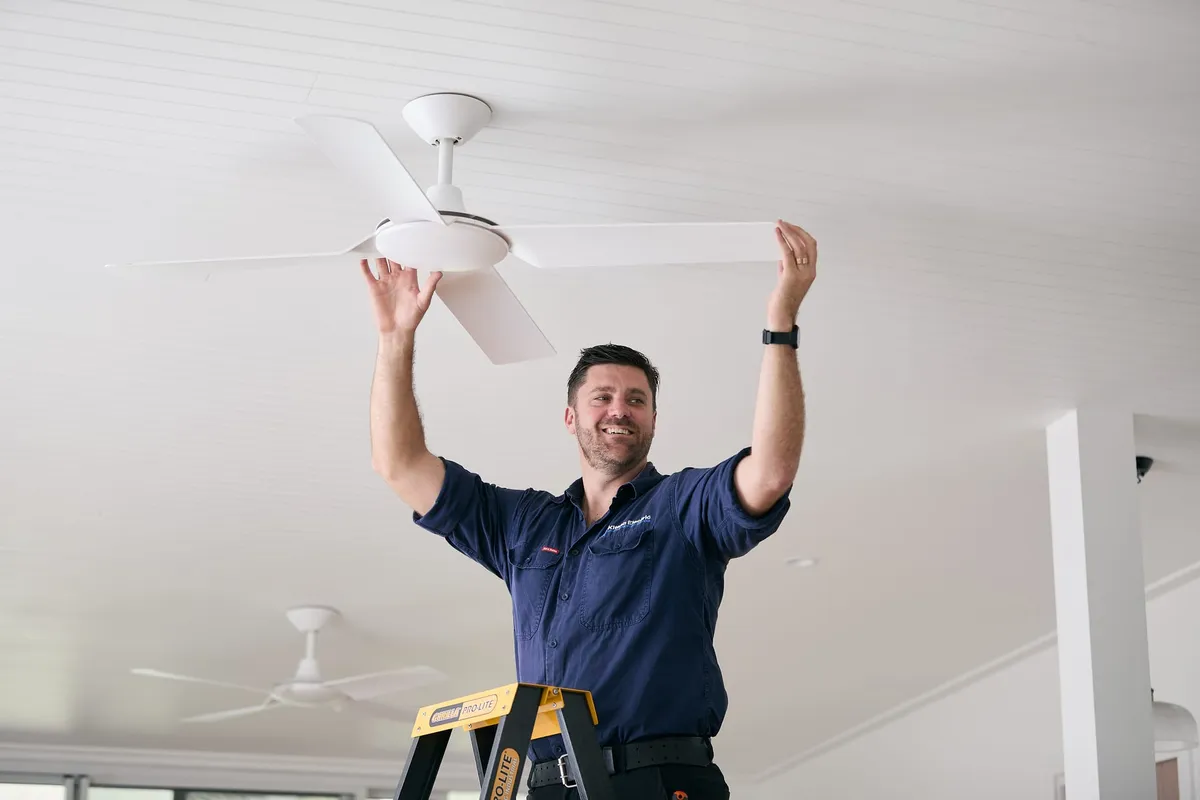
A wobbling ceiling fan in a Hamilton home is almost always mechanical. Loose mounting screws, an unbalanced blade or a bracket that has worked free. Humming is electrical, usually a failing capacitor or the wrong speed controller. Both are fixable.
Hamilton's Federation cottages and terraces come with high ceilings and old light points. Kitson Electricians Newcastle services and installs fans across the inner suburbs. This guide covers wobble, hum, what to check yourself, and when replacement beats repair.
The September Problem With Ceiling Fans
Ceiling fans are the most neglected appliance in the house. They sit still from about April, then get switched on for the first time on a warm September afternoon. Whatever went wrong last summer has had five months to settle in.
That matters more than it sounds. A fan is a heavy object turning fast, fixed overhead, often into timber that is a century old. Under AS/NZS 3000, the Australian and New Zealand Wiring Rules, blades must sit at least 2.1 metres above floor level, and the fan must be fixed to a structural member rather than to plasterboard alone.
There is a practical reason to sort it now rather than in January. Running a fan costs a small fraction of running air conditioning, and in a Newcastle spring a fan alone is usually enough. Most households I visit are surprised how much of the season they can cover before the air conditioner needs to come on at all.
What Makes a Ceiling Fan Wobble?
Wobble has six usual sources, and none of them improve with time:
- The mounting screws have loosened. Every rotation puts a small twisting load into the mount. Over years that backs the screws off, and once the bracket has play in it the wobble grows quickly. This is the most common cause I find, and the one most likely to end badly if it is ignored.
- The blades are out of balance. Blades leave the factory matched by weight. Dust builds unevenly, one blade takes a knock during cleaning, and the set no longer balances. A balancing kit corrects this in a few minutes once the imbalance is identified.
- A blade or blade holder is bent. A single blade sitting a few millimetres lower than the others throws the whole assembly out. Blade holders bend easily if a fan has been knocked, moved between houses, or cleaned with too much enthusiasm.
- The blades have warped. Timber and composite blades absorb moisture and distort, particularly in humid coastal air. Warping is easy to miss because the fan looks fine at rest and only misbehaves at speed.
- The downrod or canopy is not seated properly. On a high-ceiling installation, a downrod that was not fully seated at installation will let the fan pivot slightly. The wobble usually appears within the first season.
- The ceiling joist itself is moving. In older Hamilton cottages the fan is sometimes fixed to a batten rather than a joist. The fan can be perfect and still wobble, because the thing holding it flexes.
What Makes a Ceiling Fan Hum?
Humming is a different problem with a different fix. These are the causes worth knowing:
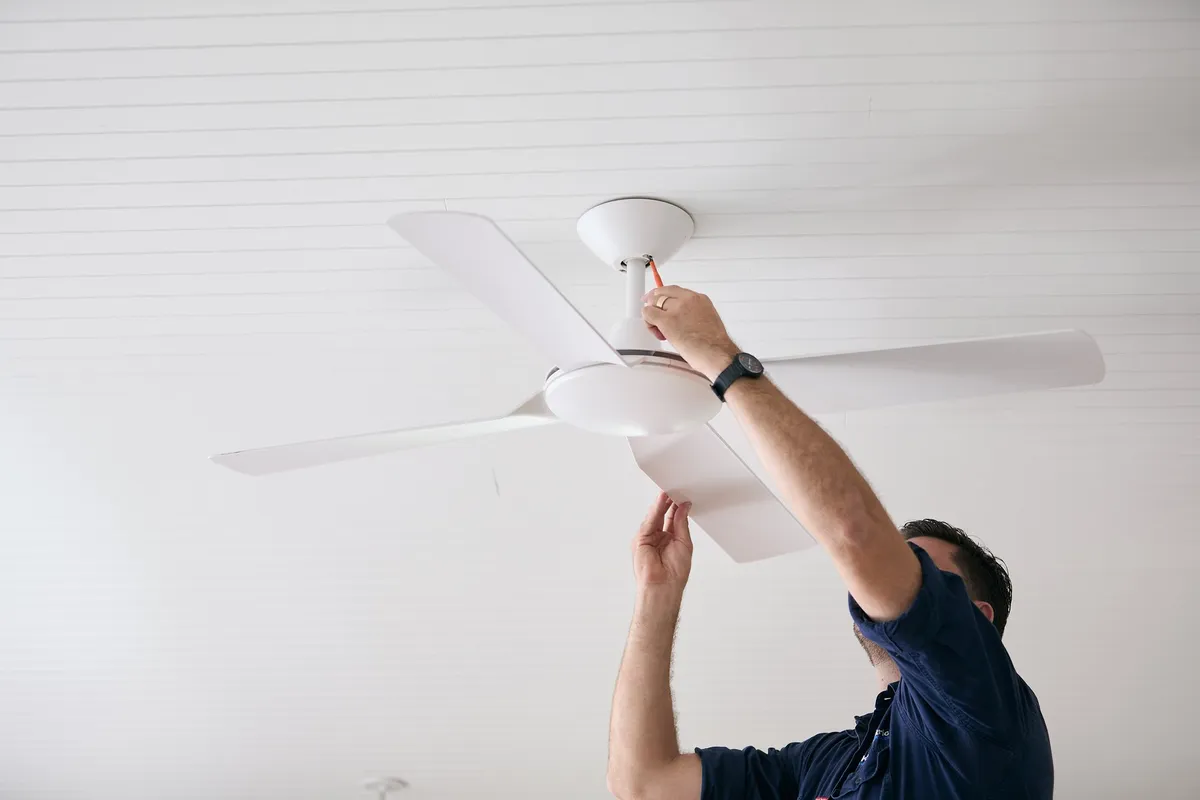
A Failing Motor Capacitor
The capacitor starts the motor and sets its speeds. As it degrades the fan hums, struggles on low, or refuses to start until you nudge a blade. It is a small part, and replacing it is often the whole repair.
The Wrong Speed Controller
Older capacitor-based wall controllers were built for the motors of their era. Pair one with a modern fan and it frequently hums at low speeds. Fitting the speed controller the manufacturer specifies usually silences it outright.
A Light Dimmer on a Fan Circuit
This one is both a noise problem and a safety problem. Light dimmers are not designed to control motors. Where a fan has been wired through one, the hum is a warning rather than a quirk.
Worn Bearings
Bearings dry out and grumble, and the sound changes with speed rather than staying constant. Bearing noise on an older fan generally signals the end of its useful life rather than a repair.
More: Why Do My Lights Flicker?
Try These Checks Before You Call
A few safe checks narrow the problem considerably. Work through this list with the fan switched off at the wall:
- Look along the blades from below and check whether one sits lower than the rest.
- Wipe each blade clean with a damp cloth and run the fan again, since dust alone causes plenty of wobbles.
- Watch whether the wobble appears at all speeds or only at high speed.
- Listen for whether the hum changes with speed or stays at exactly the same pitch.
- Note whether the fan starts on its own or needs a nudge, which points at the capacitor.
- Check whether other lights on the same circuit flicker when the fan runs.
- Stop using the fan entirely if the canopy has visibly shifted or the mount looks loose.
Cleaning and levelling are the only parts you should attempt. Anything that involves removing the canopy is electrical work.
Why Hamilton Homes Are Hard on Ceiling Fans
Hamilton's building stock creates a specific set of fan problems:
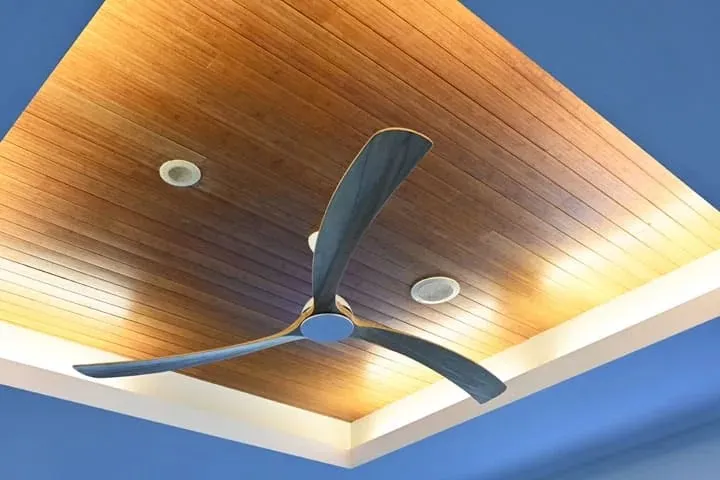
- High Federation and interwar ceilings. Ceilings of three metres and more are common through Hamilton and Hamilton South. Fans need a downrod to sit at an effective height, and a downrod that is wrong for the fan is a wobble waiting to happen.
- Fans retrofitted to old light points. Most fans in the suburb were added later, wired into an existing ceiling rose. That point was designed to hold a light fitting weighing a few hundred grams, not a fan under rotational load.
- Lath and plaster ceilings. Older Hamilton cottages have lath and plaster rather than modern sheeting. Finding and fixing to a genuine structural member takes more care, and shortcuts here show up as movement later.
- Harbour and coastal air. Hamilton sits close to the harbour, and salt carries further inland than people expect. Outdoor and alfresco fans around Hamilton and Islington corrode at the blade holders and mounting hardware years before an indoor unit would.
- Rental and share housing turnover. The streets around Beaumont Street carry a lot of rental stock. Fans in these properties run hard through summer and are rarely serviced between tenancies, so faults accumulate quietly.
When a Repair Is the Wrong Answer
Not every fan is worth saving. These are the cases where replacement is the better spend:
The Motor Is Worn
A fan that runs hot, hums constantly and has lost speed across all settings has a tired motor. Nothing short of a new unit fixes that properly.
Parts No Longer Exist
Capacitors and blade sets for discontinued models are often unobtainable. Where the part cannot be sourced, electrical repairs become a holding pattern rather than a solution.
The Fan Is Undersized for the Room
Plenty of Hamilton living rooms have a fan that was never big enough for the ceiling height and floor area. It will always underperform, no matter how well it is serviced.
You Want Light and Air From One Point
Older cottages often have a single ceiling point per room. A combined ceiling fan with light solves both needs without adding a second circuit or chasing new cable through a lath and plaster ceiling.
Getting a New Fan Right the First Time
If you are replacing rather than repairing, these decisions do most of the work:
- Size the fan to the room, not the budget. Blade span should match floor area. An undersized fan run flat out moves less air than a correctly sized one on medium, and makes far more noise doing it.
- Get the downrod length right. The aim is blades roughly 2.4 to 2.7 metres above the floor where ceiling height allows, and never below the 2.1 metre minimum. High Hamilton ceilings almost always need an extension.
- Fix to structure, every time. A proper ceiling fan installation is fixed to a joist or a purpose-installed brace. This single decision prevents most future wobble.
- Match the controller to the motor. DC motor fans need their own controller or remote. Reusing the wall controller that was already there is the most common cause of a brand new fan that hums.
- Have the circuit checked while the ceiling is open. If the fan is going into a century-old ceiling, it is worth a quick look at the wiring feeding it. Electrical fault finding at that moment costs very little.
On running costs, general household energy guidance for New South Wales is published by NSW Climate and Energy Action. Licensing and safety obligations for the contractor doing the work sit under SafeWork NSW.
More: Why Is My Electricity Bill So High? Hidden Causes
Areas We Service
Ceiling fan work covers the inner Newcastle suburbs and beyond, from Hamilton, Hamilton South and Islington through Tighes Hill, Wickham, Broadmeadow, Waratah, Mayfield, Lambton, New Lambton and Merewether. Most fan jobs are booked and completed within a few days.
Sort the Fans Now, Not on the First Hot Day
Every summer the same thing happens: the first 35 degree day arrives and every electrician in Newcastle is booked. Call Kitson Electricians Newcastle on 0438 262 792 and get it done in the quiet part of the season, with a quote back within 24 hours. Work is carried out by fully licensed and insured electricians, backed by our Lifetime Workmanship Warranty and our Clean Home Promise. First-time customers get $50 off their first service call, and any paid job includes a free $150 electrical safety inspection. You can read more about Anthony Kitson and the team before booking.
Frequently Asked Questions
Is a wobbling ceiling fan dangerous?
A slight wobble is normal. A pronounced one is not, because it means the mounting or a blade holder has loosened, and that worsens with every hour it runs.
Can I fix a ceiling fan wobble myself?
You can clean the blades and check they sit level. Anything requiring the canopy to come off is electrical work, which NSW law restricts to a licensed electrician.
Why does my ceiling fan hum on low speed only?
Low-speed hum usually points at the speed controller rather than the fan. Older capacitor-based wall controllers often hum when paired with a modern motor they were never designed for.
How high do ceiling fan blades need to be?
AS/NZS 3000 sets a minimum of 2.1 metres from the floor to the blades. Hamilton's high Federation ceilings usually need a downrod to bring the fan into an effective range.
Is it worth repairing an old ceiling fan?
Sometimes. A capacitor or a bracket is worth fixing, but a worn motor on a budget fan rarely is, since a new unit costs little more than the repair.
Can I use a light dimmer to control a ceiling fan?
No. Light dimmers are not designed for fan motors and can damage them or create a fire risk. Fans need a proper fan speed controller installed by an electrician.